
For most recreational divers, the SCUBAPRO G3 is the best all-round pick here, pairing a full-color display with a stated 300-metre Gauge Mode limit and a rechargeable battery, while the SUUNTO Ocean adds GPS route tracking above water. All five products are genuine watch-style dive computers, so the choice comes down to modes, display, depth and battery figures, and controls.
The listings differ in ways that matter. Two use AMOLED displays, one a full-color backlit display, one a segment LCD, and the Cressi a backlit display with no stated screen size. Only the SCUBAPRO gives a depth figure in metres and only the Garmin an ATM rating; three listings leave depth out entirely.
As an Amazon Associate, we earn from qualifying purchases.
Pick by Your Need
- Best for a stated depth limit: SCUBAPRO G3. Stated to 300 metres in Gauge Mode, the only metre figure here.
- Best for GPS dive tracking: SUUNTO Ocean. Dual-band GNSS, offline maps and underwater route tracking.
- Best for simple controls: Cressi Leonardo 2.0. A single-button interface runs its Air, Nitrox and Gauge modes.
- Best for technical mode lists: Mares Sirius L. Multigas Nitrox for up to three gases, plus Bottom Timer.
- Best for surface location marks: Garmin Descent G2. Multi-GNSS marks surface entry and exit points.
Quick Answer
Choose the SCUBAPRO G3 if a stated depth limit and a color screen top your list: a stainless steel housing rated to 300 metres in Gauge Mode, a full-color display, and a rechargeable battery giving up to 30 hours per charge. Choose the SUUNTO Ocean for the largest stated display here at 1.43 inches, an AMOLED touchscreen, route tracking and up to 40 hours stated in dive modes. The Garmin Descent G2 offers a 1.2-inch AMOLED display and a 10 ATM rating. The Mares Sirius L adds Multigas Nitrox for up to three gases, while the Cressi Leonardo 2.0 keeps operation to one button. All five match on type; the gaps are missing figures — the Cressi, Mares and SUUNTO listings each give no depth figure, and the Cressi and Mares listings give no battery figure — so confirm those on the product page.
Comparison Table
| Product | Display | Dive modes stated | Depth figure stated | Battery figure stated |
|---|---|---|---|---|
| Cressi Leonardo 2.0 | Backlit display | Air, Nitrox, Gauge | not stated | not stated |
| Garmin Descent G2 | 1.2-inch AMOLED, sapphire lens | Recreational, advanced, technical, freediving, pool apnea | 10 ATM dive rating | not stated |
| SCUBAPRO G3 | Full-color display with backlight | Gauge Mode stated | Up to 300 metres in Gauge Mode | Up to 30 hours per charge |
| Mares Sirius L | Segment LCD, Chip-on-Glass | Air, Nitrox, Multigas Nitrox, Freedive, Bottom Timer | not stated | not stated |
| SUUNTO Ocean | 1.43-inch AMOLED touchscreen | Freediving, snorkeling, mermaid, single and multigas | not stated | Up to 40 hours in dive modes |
Decision Guide
Start with the depth figure, because the listings handle it three different ways. The SCUBAPRO G3 states up to 300 metres, tied to Gauge Mode specifically — a gauge-mode limit, not a limit for every mode. The Garmin Descent G2 states a 10 ATM rating instead; ATM and metres use different rating bases, so this guide does not rank them against each other. The Cressi, Mares and SUUNTO listings each give no depth figure, so verify it on the product page.
Next, match modes to your diving. Every model covers recreational air and nitrox; the Mares adds Multigas Nitrox for up to three gases, the SUUNTO lists single and multigas diving, and the Garmin states support from recreational through technical diving plus freediving and pool apnea. The Mares alone states a Bottom Timer mode, Safety Stop+ guidance and its algorithm, the Buhlmann ZH-L16C with customizable gradient factors. The Cressi and SCUBAPRO listings give no multigas mode.
Displays split the set further. The Garmin and SUUNTO use AMOLED screens — 1.2 inches behind a sapphire lens, and a 1.43-inch touchscreen, the largest stated size here. The SCUBAPRO uses a full-color backlit display, the Mares a segment LCD, and the Cressi a backlit display with no stated screen size. Battery figures come from only two listings, on different bases — up to 40 hours in dive modes for the SUUNTO, up to 30 hours per charge for the SCUBAPRO — while the other three give no battery-hours figure.
1. Cressi Leonardo 2.0 Scuba Dive Computer — Best for Simple One-Button Control

The Cressi Leonardo 2.0 covers the recreational role with Air, Nitrox and Gauge modes, a backlit display and a single-button interface. Its listing gives no depth figure and no battery figure, so both need a product-page check.
Pros
- Air, Nitrox and Gauge modes, with a gauge fallback.
- Single-button interface is the simplest control scheme stated here.
- Visual and audible alarms plus phone pairing are stated.
Cons
- SCUBAPRO and Garmin state depth figures; this listing gives none beside them.
- SUUNTO and SCUBAPRO state battery hours; this listing gives no battery figure.
| Spec | From the listing |
|---|---|
| Color | Black/Pink |
| Dive modes | Air, Nitrox, Gauge |
| Display | Backlit display |
| Depth rating | The listing does not state it |
2. Garmin Descent G2 Watch-Style Dive Computer — Best for Marking Entry and Exit Points

The Garmin Descent G2 is a rugged watch-style dive computer with a 1.2-inch AMOLED display, a sapphire lens and leakproof buttons, carrying a 10 ATM dive rating. Its listing states support for recreational, advanced, technical, freediving and pool apnea, plus Multi-GNSS for marking entry and exit points. Garmin also states that all plastic in the housing, bezel and buttons comes from recycled ocean-bound plastics.
Pros
- Mode support spans recreational, advanced, technical, freediving and pool apnea.
- Multi-GNSS support lets divers mark entry and exit points.
- Full stated sizing, band fit 128 to 224 mm, makes fit checkable.
Cons
- SCUBAPRO states its depth limit in metres; this listing uses a 10 ATM rating, a different basis.
- SUUNTO states up to 40 hours in dive modes; this listing gives no battery figure.
| Spec | From the listing |
|---|---|
| Color | Black |
| Display | 1.2-inch AMOLED, sapphire lens |
| Dive rating | 10 ATM |
| Physical size | 45.5 x 45.5 x 15.2 mm |
3. SCUBAPRO G3 Wrist Scuba Dive Computer — Best for a Stated Depth Limit

The SCUBAPRO G3 puts a full-color backlit display inside a stainless steel housing, and its listing states diving up to 300 metres in Gauge Mode — the only metre-based depth figure here. A rechargeable lithium battery provides up to 30 hours per charge depending on settings. Its listing gives no display size in inches and ties the depth figure to Gauge Mode, so check the product page for other modes.
Pros
- Stated depth limit of 300 metres in Gauge Mode is the only metre figure here.
- Full-color display with backlight and a stainless steel housing.
- Rechargeable battery stated at up to 30 hours per charge.
Cons
- SUUNTO states a 1.43-inch display size; this listing gives no screen size.
- Garmin states five dive categories; this listing details Gauge Mode only.
| Spec | From the listing |
|---|---|
| Color | Black |
| Housing | Stainless steel |
| Depth limit | Up to 300 meters / 984 ft in Gauge Mode |
| Battery | Rechargeable lithium, up to 30 hours per charge |
| Display | Full-color with backlight |
4. Mares Sirius L Wrist Diving Computer — Best for Multigas Mode Lists

The Mares Sirius L is a lightweight watch-style computer with a Chip-on-Glass segment LCD. Its stated mode list is the widest here: Air, Nitrox, Multigas Nitrox for up to three gases, Freedive and Bottom Timer. Decompression runs on the Buhlmann ZH-L16C algorithm with customizable gradient factors. Its listing gives no depth figure and no battery figure.
Pros
- Multigas Nitrox for up to three gases, plus Freedive and Bottom Timer.
- Buhlmann ZH-L16C algorithm with customizable gradient factors is specified.
- Safety Stop and Safety Stop+ features monitor ascent profiles.
Cons
- SCUBAPRO and Garmin state depth figures; this listing gives no depth figure.
- SUUNTO and SCUBAPRO state battery hours; this listing gives no battery figure.
| Spec | From the listing |
|---|---|
| Color | Black |
| Display | Segment LCD, Chip-on-Glass |
| Dive modes | Air, Nitrox, Multigas Nitrox, Freedive, Bottom Timer |
| Algorithm | Buhlmann ZH-L16C, customizable gradient factors |
5. SUUNTO Ocean Dive Computer GPS Watch — Best for Route Tracking and Multisport U
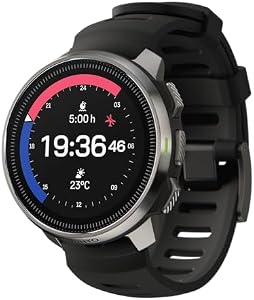
The SUUNTO Ocean is a dive computer and multisport watch built around a 1.43-inch AMOLED touchscreen — the largest stated display here. Its listing states freediving, snorkeling, mermaid diving, and single and multigas diving with air and nitrox, plus underwater route tracking and wireless tank pressure support. Its listing gives no depth figure, so verify that on the product page.
Pros
- Largest stated display here at 1.43 inches, an AMOLED touchscreen.
- Underwater route tracking, dual-band GNSS and offline maps are stated.
- Battery stated at up to 40 hours in dive modes, with 26-day standby.
Cons
- SCUBAPRO states a 300-metre Gauge Mode limit; this listing gives no depth figure.
- Cressi and Mares state one and two buttons; this touchscreen model is one glove wearers should check on the product page.
| Spec | From the listing |
|---|---|
| Color | Steel Black |
| Display | 1.43-inch AMOLED touchscreen |
| Dive modes | Freediving, snorkeling, mermaid, single and multigas |
| Battery | Up to 40 hours in dive modes |
Shopping Checklist
- Measure your wrist first against any stated band or case size.
- Check the stated depth limit or water rating for the exact mode you plan to dive.
- Check which gases and dive modes the listing states, and confirm any missing figure on the product page.
- Check the stated battery basis — per charge, dive modes or standby — not hours across bases.
- Compare two or three finalists side by side on display and controls.
- Check the return window on the product page, and do not buy a size you did not measure.
FAQ
How do I choose a dive computer watch for scuba diving?
Start with the dive modes you will actually use — air and nitrox cover most recreational diving, while multigas support matters for planned gas switches — then check the stated depth limit or water rating for those modes, compare display and controls, and treat any missing figure as a product-page check.
Does the water rating basis matter when comparing models?
Yes. A limit stated in metres and a rating stated in ATM come from different bases, and a metre figure may be tied to one mode, such as Gauge Mode. Compare each model on its own stated basis, and confirm your mode’s limit on the product page.
What should I verify on the product page before buying?
Verify any figure the listing leaves out — depth limits, battery life, display size or band fit — and the return window. If two finalists state battery hours on different bases, read the conditions attached to each figure.
Final Verdict
All five are genuine watch-style dive computers, so this choice turns on stated figures, not product type. The SCUBAPRO G3 is the default pick for divers who want a confirmed number: the only stated depth limit in metres, at 300 metres in Gauge Mode, with a color display and a 30-hour rechargeable battery. The SUUNTO Ocean fits divers who also train on the surface, with the largest stated display and 40 hours stated in dive modes. The Garmin Descent G2 suits divers who want entry and exit marking, the Mares Sirius L is the pick for multigas planning, and the Cressi Leonardo 2.0 keeps things simplest with one button. Where a listing gives no depth or battery figure — the Cressi and Mares on both, the SUUNTO on depth, the Garmin on battery — check the product page before you commit.
Prime covers fast, free delivery on eligible items. See whether a Prime free trial is available for your account.
Check Prime on Amazon →Product and ASIN Reference
| Product | ASIN |
|---|---|
| Cressi Leonardo 2.0 | B006GT50WC |
| Garmin Descent G2 | B0DX1T7JQ3 |
| SCUBAPRO G3 | B0CF4DZRTB |
| Mares Sirius L | B0FJLRKKYX |
| SUUNTO Ocean | B0D41N79NC |

Write Your Review
No reviews yet. Be the first to share your experience!