
For handheld stills and video, the Fujifilm X-T5 suits light travel best, while the Canon EOS R5 suits large prints and 8K work. The two Sony a7 V versions share a 33.0-megapixel sensor, so the choice between them turns on whether a 28-70mm lens in the box matters. The Canon EOS R6 Mark II sits at the lower-resolution end of this group at 24.2 megapixels, yet its oversampled 4K at 60p keeps it relevant for hybrid creators.
Stabilization ratings alone do not settle this comparison, because the makers state them in different ways. Sensor size, resolution, burst speed, video ceiling, and box contents differ more.
As an Amazon Associate, we earn from qualifying purchases.

Pick by Your Need
- Best overall: Sony Alpha a7 V Body. Its 33.0-megapixel sensor and 30 frames per second burst cover stills and video.
- Best for large prints: Canon EOS R5. Its 45MP sensor and 8K video up to 30p suit detailed stills.
- Best for light travel: Fujifilm X-T5. At 1.0 pounds it is the lightest stated body here, with 40.2 megapixels.
- Best ready-to-shoot kit: Sony Alpha a7 V with FE 28-70mm Lens. It adds a zoom lens, with stated battery figures.
- Best for 4K hybrid work: Canon EOS R6 Mark II. Its oversampled 4K video at up to 60p suits hybrid creators.
Quick Answer
The Fujifilm X-T5 is the lightest stated body here at 1.0 pounds and 40.2 megapixels, while the Canon EOS R5 carries the highest stated resolution at 45MP and the only stated 8K recording. The Sony pair shares a 33.0-megapixel sensor and a 30 frames per second burst, while the R6 Mark II offers oversampled 4K at 60p.
Comparison Table
| Product | Best for | Key figures from the listing | Trade-off |
|---|---|---|---|
| Sony Alpha a7 V Body | Balanced stills and video | 33.0 megapixels; 7.5-step central stabilization; 1.35 pounds | Body only |
| Canon EOS R5 | Large prints and 8K video | 45MP; 8K up to 30p; 4K up to 120p; 2.0 pounds | Ties the R6 Mark II at 2.0 pounds |
| Fujifilm X-T5 | Light travel and high detail | 40.2 megapixels; up to 7 stops; 15 frames per second; 1.0 pounds | Smaller APS-C sensor |
| Sony Alpha a7 V with FE 28-70mm Lens | A complete starting kit | 33.0 megapixels; 630 shots with the viewfinder; 750 shots with the LCD | Size and weight match the body-only version |
| Canon EOS R6 Mark II | 4K hybrid shooting | 24.2 megapixels; oversampled 4K up to 60p; 2.0 pounds | Lowest stated resolution here |
Decision Guide
Resolution sets the first split. The Canon EOS R5 states 45MP, the Fujifilm X-T5 states 40.2 megapixels, the Sony pair states 33.0 megapixels, and the Canon EOS R6 Mark II states 24.2 megapixels. Higher stated resolution suits heavy cropping and large prints, while the R6 Mark II figure still covers portraits, weddings, and events named in its listing.
Stabilization figures need a careful read because the brands state them differently. Sony gives central and peripheral figures of 7.5 and 6.5 steps for both a7 V versions, Fujifilm gives up to 7 stops for the X-T5, and Canon gives 5-axis stabilization for both bodies and no step figure is stated. No step figure is stated for either Canon body, so the five cannot be compared on one numeric scale.
Video ceilings form the next split. The R5 is the only pick that states 8K video, recording up to 30p, with 4K up to 120p for slow motion, while the R6 Mark II states oversampled 4K UHD video at up to 60p, slow-motion Full HD at 180p, Canon Log 3, and HDR PQ. No video resolution ceiling is stated for the Sony pair or the Fujifilm listing.
On weight, the X-T5 states 1.0 pounds, the Sony pair states 1.35 pounds, and both Canon bodies state 2.0 pounds. The Sony kit adds a 28-70mm lens, while both Canon bundles add a lens, a 64GB card, and a shoulder bag. Kit buyers should confirm exactly which accessories arrive in the box.
One conflict deserves attention. The Sony a7 V kit states the same dimensions, 2.84 inches by 5.12 inches by 3.79 inches, and the same weight, 1.35 pounds, as the body-only Sony a7 V, even though the kit includes a 28-70mm lens, so check the product page to confirm whether the stated figures describe the body alone or the kit as packed.
1. Sony Alpha a7 V Body — Best Overall
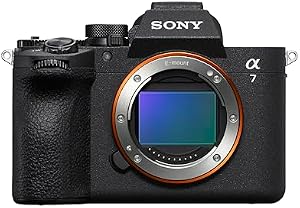
A partially stacked Exmor RS CMOS sensor gives this body-only Sony a stated readout about 4.5 times faster than the earlier a7 IV and a burst of 30 frames per second. The BIONZ XR2 engine delivers up to 16 stops of dynamic range, and gyro sensors correct shake at up to 7.5 steps centrally and 6.5 steps at the periphery. At 5.12 inches wide and 1.35 pounds, it leaves lens choice entirely open.
Pros
- 33.0-megapixel partially stacked sensor
- Burst of 30 frames per second, maximum shutter speed of 1/16000 s
- Up to 16 stops of dynamic range
Cons
- Body only, so a lens must be bought separately
- No video resolution ceiling is stated in the listing details
| Spec | From the listing |
|---|---|
| Sensor | 33.0-megapixel partially stacked Exmor RS CMOS sensor |
| Stabilization | Up to 7.5-step central and 6.5-step peripheral stabilization |
| Burst | 30 frames per second |
| Weight | 1.35 pounds |
2. Canon EOS R5 Mirrorless Camera — Best for Large Prints
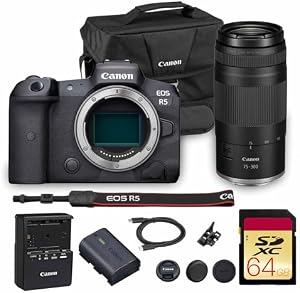
Resolution is the main reason to choose this Canon: its 45MP full-frame sensor is the highest stated resolution here, ahead of the 40.2-megapixel Fujifilm and the 33.0-megapixel Sony pair. Its video ceiling is also the highest stated ceiling here, with 8K recording up to 30p and 4K up to 120p for slow motion, with Dual Pixel CMOS AF and 5-axis stabilization. The bundle lists a 75-300mm lens, a 64GB card, and a bag, and the stated body measures 6.0 inches wide and 2.0 pounds.
Pros
- 45MP full-frame sensor for large prints
- 8K video up to 30p and 4K video up to 120p for slow motion
- Bundle lists a 75-300mm lens, card, and bag
Cons
- At 2.0 pounds it ties for the heaviest stated weight here
- No stabilization step figure is stated in the listing details
| Spec | From the listing |
|---|---|
| Sensor | 45MP full-frame CMOS sensor |
| Video | 8K up to 30p; 4K up to 120p |
| Autofocus | Dual Pixel CMOS AF with subject tracking |
| Stabilization | 5-axis in-body image stabilization |
| Weight | 2.0 pounds |
3. Fujifilm X-T5 Mirrorless Camera Body — Best for Light Travel

Light weight is the Fujifilm advantage, because its stated weight of 1.0 pounds undercuts the Sony pair by 0.35 pounds and both Canon bodies by 1.0 pounds, while its 40.2-megapixel APS-C sensor still outresolves the Sony pair and the 24.2-megapixel Canon. Its mechanical shutter reaches 15 frames per second, its stabilization reaches up to 7 stops, and its pixel shift multi shot reaches 160MP, the only stated pixel shift figure here. The trade-off is sensor size: the listing names a smaller APS-C sensor.
Pros
- Stated weight of 1.0 pounds, the lightest stated weight here
- 40.2-megapixel sensor with 160MP pixel shift multi shot
- Body stabilization rated up to 7 stops
Cons
- Smaller APS-C sensor against four full-frame bodies
- A video resolution ceiling is not stated
| Spec | From the listing |
|---|---|
| Sensor | 40.2-megapixel APS-C X-Trans CMOS 5 HR BSI sensor |
| Stabilization | Up to 7 stops of internal body image stabilization |
| Burst | 15 frames per second in mechanical shutter |
| Pixel shift | 160MP pixel shift multi shot |
| Weight | 1.0 pounds |
4. Sony Alpha a7 V with 28-70mm Lens — Best Ready-to-Shoot Kit
This kit shares the body-only Sony sensor, engine, and stabilization figures exactly, including a 33.0-megapixel partially stacked sensor and a central stabilization figure of 7.5 steps. Its advantage is completeness: the box includes a 28-70mm lens, and the listing states battery life of 630 shots with the viewfinder and 750 shots with the LCD. Skip it if a 28-70mm zoom does not match the focal lengths already owned.
Pros
- 33.0-megapixel partially stacked sensor with AI autofocus and Real-time Tracking
- Kit includes a 28-70mm lens for shooting straight from the box
- 630 viewfinder shots and 750 LCD shots stated
Cons
- Stated dimensions and weight match the body-only version exactly, despite the included lens
- A video ceiling is not stated
| Spec | From the listing |
|---|---|
| Sensor | 33.0-megapixel partially stacked Exmor RS CMOS sensor |
| Stabilization | Up to 7.5-step central and 6.5-step peripheral stabilization |
| Burst | 30 frames per second |
| Battery | 630 shots with the viewfinder; 750 shots with the LCD |
| Weight | 1.35 pounds |
5. Canon EOS R6 Mark II Camera — Best for 4K Hybrid Work

Video is where this Canon earns its place, because its oversampled 4K UHD recording reaches up to 60p, with Full HD slow motion at 180p and Canon Log 3 listed alongside it, a combination no other pick states in full. Its 24.2MP full-frame sensor is the lowest stated resolution here, 20.8 megapixels below the R5 and 16.0 megapixels below the Fujifilm, yet the listing still names portraits, weddings, and events as suitable uses. Dual Pixel AF II plus 5-axis stabilization supports fast action and handheld shooting.
Pros
- Oversampled 4K UHD at up to 60p, with Canon Log 3 and HDR PQ
- Slow-motion Full HD at 180p for slowed footage
- Bundle lists a 28-70mm lens, a 64GB card, and a bag
Cons
- 24.2MP is the lowest stated resolution here
- At 2.0 pounds it ties the R5 for the heaviest stated weight here
| Spec | From the listing |
|---|---|
| Sensor | 24.2MP full-frame sensor |
| Video | Oversampled 4K UHD up to 60p; Full HD 180p slow motion |
| Autofocus | Dual Pixel AF II with AI subject tracking |
| Stabilization | 5-axis in-body image stabilization |
| Weight | 2.0 pounds |
Shopping Checklist
- Compare stated resolution against the print size planned.
- Check for a stabilization step figure.
- Confirm whether the box holds a body only or a bundle.
- Measure stated dimensions and weight against the camera bag.
- Verify the stated video ceiling against the recording planned.
FAQ
Which of these five has the highest stated resolution?
The Canon EOS R5 states 45MP. Next comes the Fujifilm X-T5 at 40.2 megapixels, then the Sony pair at 33.0 megapixels, and last the Canon EOS R6 Mark II at 24.2 megapixels.
How do the stated stabilization figures compare?
The Sony pair states 7.5 steps at the centre and 6.5 steps at the edge, the Fujifilm carries up to 7 stops, and the Canon pair carries 5-axis stabilization and no step figure is stated. Without a step figure for either Canon body, the five cannot be ranked on one scale.
Which pick suits a buyer who wants a lens in the box?
The Sony kit includes a 28-70mm lens, the R5 bundle lists a 75-300mm lens, and the R6 Mark II bundle lists a 28-70mm lens, while the Sony body and the Fujifilm X-T5 are body-only. Check the product page for which accessories arrive in each box.
Final Verdict
The Fujifilm X-T5 suits the lightest stated kit at 1.0 pounds with 40.2 megapixels, the Canon EOS R5 suits the largest prints and 8K recording at 45MP, and the Sony pair suits balanced stills and video at 33.0 megapixels. The Sony kit suits buyers who want a 28-70mm lens in the box, while the R6 Mark II suits hybrid creators who value oversampled 4K at 60p over maximum resolution. Confirm the conflicting Sony kit figures, then choose by resolution and video ceiling.
Prime covers fast, free delivery on eligible items. See whether a Prime free trial is available for your account.
Check Prime on Amazon →Product and ASIN Reference
| Product | ASIN |
|---|---|
| Sony Alpha a7 V Full-Frame Mirrorless Camera Body | B0G4SC4R2P |
| Canon EOS R5 Mirrorless Camera | B0FSFSNGJ9 |
| FUJIFILM X-T5 Mirrorless Digital Camera Body – Black | B0FC81M3Z4 |
| Sony Alpha a7 V Mirrorless Camera with FE 28-70mm Lens | B0G4SDZP3D |
| Canon EOS R6 Mark II Mirrorless Camera | B0FSS4F7KG |

Write Your Review
No reviews yet. Be the first to share your experience!