
The widest connector choice in this group is the HyperX Cloud III, with USB-C, USB-A and 3.5 mm in the box. If you want to move around the room without a cable, the wireless model in this roundup is the only one with a stated battery figure, at up to 29 hours. The other three wired models differ mainly in driver size, mic design and lighting, so the right pick depends on which of those three matters most to you.
All five headsets in this guide are white, over-ear models built for gaming. Three of them list a driver size: one at 53 mm and two at 50 mm. Two list a weight: 240 g and 278 g. One lists wireless range and battery life, while the other four connect by cable. The sections below compare those stated figures side by side, so you can match a headset to your platform, your desk layout and the way you chat with teammates.
As an Amazon Associate, we earn from qualifying purchases.
Pick by Your Need
- Best overall: HyperX Cloud III. Its 53 mm drivers are the largest driver figure stated in this roundup, and it includes USB-C, USB-A and 3.5 mm connections.
- Best lightweight wired pick: Razer BlackShark V2 X. It lists a weight of 240 g, which is less than the 278 g stated for the wireless model here.
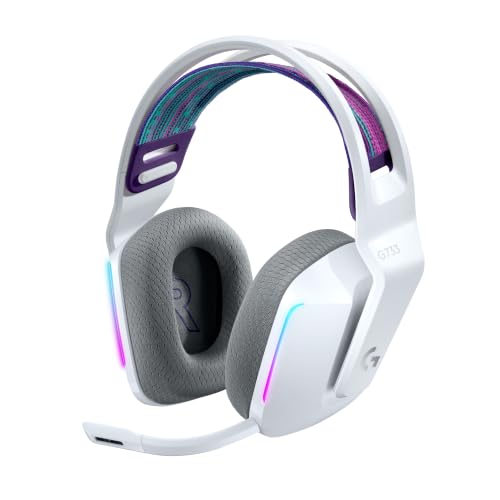
- Best wireless pick: Logitech G733. It lists up to 29 hours of battery life and up to 20 m of wireless range.
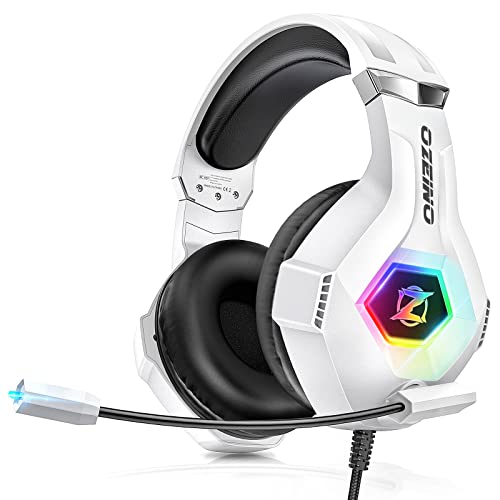
- Best RGB wired pick: Ozeino Gaming Headset. It lists colorful RGB lights and 7.1 surround sound through a 3.5 mm connection.
- Best control-box pick: FIFINE H9W. It lists a USB control box for headset volume, mic volume and mic mute, plus a detachable microphone.
Quick Answer
Choose the HyperX Cloud III if you want the largest stated driver size and three connection types in one box. Choose the Logitech G733 if you want wireless play with a stated battery life of up to 29 hours. Choose the Razer BlackShark V2 X if you want the lightest stated weight at 240 g with a 3.5 mm connection that works across PC, Mac, PlayStation 4, Xbox One and Nintendo Switch.
Comparison Table
| Product | Driver size | Weight / Battery | Connectivity | One trade-off |
|---|---|---|---|---|
| HyperX Cloud III | 53 mm, angled | Weight not stated; wired, no battery | USB-C, USB-A, 3.5 mm | Wired only, with no wireless option listed |
| Razer BlackShark V2 X | 50 mm TriForce | 240 g; wired, no battery | 3.5 mm | 7.1 surround sound is limited to Windows 10 64-bit |
| Logitech G733 | Not stated | 278 g; up to 29 hours | LIGHTSPEED wireless, USB dongle | Driver size is not listed |
| Ozeino Gaming Headset | Not stated | Weight not stated; wired, no battery | 3.5 mm, plus USB for LED lighting only | USB connector powers the LED lighting only |
| FIFINE H9W | 50 mm | Weight not stated; wired, no battery | USB and 3.5 mm | Wired only, with no wireless option listed |
Decision Guide
Start with the connection, because it decides which devices each headset can join without extra hardware. The HyperX Cloud III lists three connectors in the box: USB-C, USB-A and 3.5 mm, and it names PC, PS5, PS4, Xbox Series X|S, Xbox One, Nintendo Switch, Mac and mobile devices as compatible. The FIFINE H9W lists two: USB and 3.5 mm, with USB for PC and PS5 and the 3.5 mm jack for Xbox, controller and Switch. The Razer BlackShark V2 X and the Ozeino headset both connect through a 3.5 mm jack, so they suit setups where a single analogue connection is enough. The Logitech G733 is the wireless model here, using a USB dongle, and its console play is stereo only through that dongle on PlayStation 5, PlayStation 4 and Nintendo Switch in Dock mode.
If you play on a PC and a console from the same desk, the HyperX model covers the widest stated platform list with the most connector types. If your setup is PC only and you want wireless freedom, the G733 lists up to 20 m of wireless range, which is the only range figure in this roundup. If you play on an older Xbox One controller, note that the Razer listing says a stereo adapter may be required and is purchased separately, and the Ozeino listing says an extra Microsoft Adapter is needed for an old version Xbox One controller.
Next, compare driver size, and treat a missing figure as a gap rather than a guess. The HyperX Cloud III lists angled 53 mm drivers, tuned by HyperX audio engineers. The Razer BlackShark V2 X lists 50 mm TriForce drivers, a design that divides the driver into three parts for the individual tuning of highs, mids and lows. The FIFINE H9W also lists 50 mm drivers. The Logitech G733 and the Ozeino headset give no driver size, so they cannot be ranked on that measure from the listing details. A larger stated driver figure does not by itself prove a better result, but it is the one audio figure you can compare directly across the three models that list it.
Weight is the next figure to check, and only two models list one. The Razer BlackShark V2 X lists 240 g, and the Logitech G733 lists 278 g, a difference of 38 g between the two stated figures. The other three models give no weight figure, so a buyer who wants the lightest headset can only compare the two that list a number. Both models that list a weight also describe memory foam ear cushions: the Razer model pairs its 240 g figure with thicker headband padding and leatherette with memory foam ear cushions, while the G733 pairs its 278 g figure with a suspension headband and dual-layer memory foam. The HyperX model lists memory foam in the headband and ear cushions wrapped in leatherette, and the FIFINE model lists headbands and earmuffs in protein leather, but neither lists a weight to go with those descriptions.
Battery life applies to one model only. The G733 lists up to 29 hours of battery life, and it is the only headset in this roundup with a battery figure at all. The other four are wired models, so battery life does not apply to them and no charging figure is listed for them. If you want wireless play, the G733 is therefore the only option among these five, and its 29-hour figure is the number to weigh against its 278 g weight and its missing driver size.
Mic design is where the five models split most clearly. The HyperX Cloud III lists an upgraded 10 mm microphone with noise cancelling, a built-in mesh filter and an LED mic mute indicator. The Razer BlackShark V2 X lists a bendable HyperClear cardioid mic with an improved pickup pattern that tapers off towards the back and sides. The G733 lists Blue VO!CE mic technology with advanced mic filters that can be customized with G HUB software. The Ozeino headset lists a 360-degree omnidirectionally rotatable microphone with noise cancellation. The FIFINE H9W lists a detachable microphone, the only detachable mic in this roundup, plus a USB control box that adjusts headset volume, mic volume and mic mute. If you share a mic between setups or pack it away often, the detachable design is the practical difference. If you want mute status at a glance, the HyperX LED indicator is the only one listed. If you want on-the-fly mic control without opening a menu, the FIFINE control box and the HyperX earcup controls are the two options listed.
Surround sound needs a careful read, because the listings attach conditions to it. The Razer model lists 7.1 surround sound that is only available on Windows 10 64-bit. The Ozeino headset lists 7.1 surround sound without a platform limit in the listing facts, and the FIFINE H9W lists 7.1 surround sound as well. The HyperX and Logitech listings do not use a 7.1 label in the listing details. If surround sound on a console is part of your plan, check the product page for the exact platform terms before choosing, because the Razer condition shows that the label alone does not tell the whole story.
Lighting is a visible difference, and it comes with a wiring note on one model. The G733 lists front-facing, dual-zone LIGHTSYNC RGB lighting across about 16.8 million colors, with preset animations or custom settings through G HUB software. The Ozeino headset lists colorful RGB lights, and its listing notes that the USB connector is for LED lighting only, which means the audio still travels through the 3.5 mm connection. The HyperX, Razer and FIFINE listings give no RGB lighting figure, so if lighting matters to your setup, the choice is between the G733 and the Ozeino model, and the Ozeino model needs a USB port free for its lights.
Finally, check the physical size against your desk and storage. The G733 lists dimensions of 8.3 by 8.4 by 4 inches, the largest footprint in this group by width. The FIFINE H9W lists 7.61 by 6.57 by 2.6 inches. The Ozeino headset lists 7.48 by 4.05 by 8.07 inches. The HyperX Cloud III lists 6.1 by 3.41 by 7.48 inches, the narrowest width listed here. The Razer BlackShark V2 X lists 6.5 by 7.88 by 3.94 inches. Those figures describe the headset as listed, not a case or stand, so measure your shelf or hook against the longest listed dimension before you decide where it will live between sessions.
The short version of the guide above is a chain of three checks: connection first, then driver size and weight, then mic and lighting. Connection decides compatibility. Driver size and weight decide how the headset compares on the two numbers most models list. Mic design and lighting decide the day-to-day details, from mute control to RGB light. Work through those three checks in order and the five models separate cleanly, because each one leads on a different check.
HyperX Cloud III Wired Headset
Badge: Best for Wired Multi-Platform Play
This headset leads this roundup on two stated figures at once: its angled drivers measure 53 mm, larger than the 50 mm figure stated for the Razer and FIFINE models, and it includes three connection types, USB-C, USB-A and 3.5 mm, where the other wired models list one or two. Its 10 mm microphone adds noise cancelling, a built-in mesh filter and an LED mute indicator, a combination no other model in this group lists in full. Its listed platform range runs from PC and Mac to PS5, PS4, Xbox Series X|S, Xbox One, Nintendo Switch and mobile devices, and its earcup controls put volume and mic mute on the headset itself.
| Spec | From the listing |
|---|---|
| Driver size | 53 mm, angled |
| Microphone | 10 mm, noise-cancelling, with LED mute indicator |
| Connectivity | USB-C, USB-A and 3.5 mm |
| Frame | Full metal frame |
| Dimensions | 6.1 x 3.41 x 7.48 inches |
| Color | White |

Razer BlackShark V2 X Headset
Badge: Best Lightweight Wired Pick
This headset lists a weight of 240 g, which is 38 g less than the 278 g stated for the Logitech G733, and it is the only model here with a weight figure below that mark. Its 50 mm TriForce drivers divide the driver into three parts for the individual tuning of highs, mids and lows, and its closed earcups are described as providing passive noise cancellation with a closer seal. Its bendable HyperClear cardioid mic is shaped to pick up more voice and less noise from the back and sides. Skip it if you want 7.1 surround sound outside Windows, because the listing limits that feature to Windows 10 64-bit.
| Spec | From the listing |
|---|---|
| Driver size | 50 mm TriForce |
| Microphone | Bendable HyperClear cardioid mic |
| Connectivity | 3.5 mm audio jack |
| Weight | 240 g |
| Dimensions | 6.5 x 7.88 x 3.94 inches |
| Color | White |

Logitech G733 Lightspeed Wireless Headset
Badge: Best for Wireless Play
This headset is the only wireless model among the five, and it is the only one with a battery figure, at up to 29 hours, and a wireless range figure, at up to 20 m. Its LIGHTSYNC RGB lighting covers about 16.8 million colors across two front-facing zones, with preset animations or custom settings through G HUB software, and its suspension headbands are reversible, with a matching color on each side. Its Blue VO!CE mic technology lists advanced filters that can be customized with G HUB, and its PRO-G drivers are described as reducing distortion. The trade-off is the missing driver size: no driver figure is listed, so it cannot be ranked against the 53 mm and 50 mm figures stated for the other models.
| Spec | From the listing |
|---|---|
| Driver size | The listing does not state it |
| Microphone | Blue VO!CE mic technology |
| Battery life | Up to 29 hours |
| Wireless range | Up to 20 m |
| Weight | 278 g |
| Dimensions | 8.3 x 8.4 x 4 inches |
| Color | White |
Ozeino 7.1 Surround Gaming Headset
Badge: Best RGB Wired Pick
This headset pairs 7.1 surround sound with colorful RGB lights, a combination the other wired models do not list together, and its microphone rotates a full 360 degrees with noise cancellation for team chat. Its over-ear pads use protein material and its adjustable headband is described as distributing pressure evenly, while its listed compatibility runs across PC, PS5, PS4, Xbox One, Xbox Series X/S, Switch, laptop and mobile phone through a 3.5 mm jack. Skip it if you want a driver figure to compare, because no driver size is listed for this model. Its USB connector powers the LED lighting only, and PC use needs the included 1-to-2 3.5 mm splitter cable, with the red plug for mic and the green plug for audio.
| Spec | From the listing |
|---|---|
| Driver size | The listing does not state it |
| Microphone | 360-degree rotatable, noise-cancelling |
| Connectivity | 3.5 mm jack, plus USB for LED lighting only |
| Surround sound | 7.1 surround sound |
| Dimensions | 7.48 x 4.05 x 8.07 inches |
| Color | White |
FIFINE H9W Wired Gaming Headset
Badge: Best for Detachable Mic and Control Box
This headset is the only one in this roundup with a detachable microphone, and it pairs that mic with a USB control box that adjusts headset volume, mic volume and mic mute without opening a menu. Its 50 mm drivers match the Razer figure and sit below the 53 mm figure stated for the HyperX model, and it lists 7.1 surround sound alongside dual USB and 3.5 mm connectivity. Its headbands and earmuffs use protein leather, and its USB connection covers PC and PS5 while the 3.5 mm jack covers Xbox, controller and Switch. The control box is the practical difference here: no other model in this group lists a separate box for volume and mic controls.
| Spec | From the listing |
|---|---|
| Driver size | 50 mm |
| Microphone | Detachable microphone |
| Connectivity | USB and 3.5 mm |
| Surround sound | 7.1 surround sound |
| Dimensions | 7.61 x 6.57 x 2.6 inches |
| Color | White |
Buying Checklist
- Measure your desk and the distance to your PC or console, then check the connection type listed for the headset against the ports on your device.
- Check the stated driver size, weight and battery life where listed, and compare two or three finalists side by side on those figures.
- Check the mic design: detachable, bendable, rotatable or fixed, plus whether a mute control or mute indicator is listed.
- Check the platform terms for surround sound and console play, since the Razer listing limits 7.1 surround sound to Windows 10 64-bit and the Logitech listing notes stereo-only console play.
- Check the return window on the product page before ordering, and confirm the listed color is white.
FAQ
How do I choose between wired and wireless white gaming headsets?
Start with the connection your setup needs. Four of the five models here connect by cable, and only the Logitech G733 lists wireless play, with up to 29 hours of battery life and up to 20 m of range. If you play at a fixed desk and want the widest connector choice, the HyperX Cloud III lists USB-C, USB-A and 3.5 mm in the box.
What driver size should I look for in a white gaming headset?
Use the stated figures as the comparison, not a guess. The HyperX Cloud III lists 53 mm drivers, while the Razer BlackShark V2 X and the FIFINE H9W each list 50 mm drivers. The Logitech G733 and the Ozeino headset list no driver size, so they cannot be ranked on that figure from the listing details.
Will these headsets work with consoles as well as a PC?
All five list console compatibility in some form, but the terms differ. The HyperX model names PC, PS5, PS4, Xbox Series X|S, Xbox One, Nintendo Switch, Mac and mobile devices. The Logitech G733 works with PlayStation 5, PlayStation 4 and Nintendo Switch in Dock mode through its USB dongle, with stereo sound only on those consoles.
Final Verdict
The HyperX Cloud III is the pick for buyers who want the largest stated driver size and three connection types in one box. The Logitech G733 is the pick for buyers who want wireless play, with the only battery figure in this roundup at up to 29 hours. The Razer BlackShark V2 X is the pick for buyers who want the lightest stated weight at 240 g, the FIFINE H9W is the pick for buyers who want a detachable mic with a control box, and the Ozeino headset is the pick for buyers who want RGB lighting with 7.1 surround sound on a wired connection.
Prime covers fast, free delivery on eligible items. See whether a Prime free trial is available for your account.
Check Prime on Amazon →Types of Headsets and Headphones
Headsets and headphones are grouped mainly by connection type and by how they handle outside noise.
Wired headsets avoid battery concerns and input lag. Wireless/Bluetooth headsets remove the cable but add some latency and depend on battery charge. Open-back headphones let sound (and some noise) pass through the ear cup, generally giving a more natural soundstage; closed-back headphones seal the ear cup for more isolation and bass. Active noise cancellation (ANC) uses electronics to actively cancel outside noise; passive isolation just physically blocks sound via the ear cup's seal, with no electronics involved.
Wireless gaming headsets using a dedicated USB receiver generally have less audio lag than Bluetooth, since standard Bluetooth audio codecs add more processing delay than a direct wireless link.
Frequently Asked Questions
What's the difference between active noise cancellation (ANC) and passive isolation?
ANC uses electronics to actively cancel outside noise; passive isolation just physically blocks sound via the ear cup's seal, with no electronics or battery involved.
Open-back vs closed-back headphones — what's the real-world difference?
Open-back designs let sound pass through the ear cup for a more natural soundstage but leak sound both ways; closed-back designs seal the ear cup for more isolation and typically stronger bass.
Does a wireless gaming headset add noticeable audio lag compared to wired?
A dedicated USB receiver generally adds less lag than standard Bluetooth, since common Bluetooth audio codecs add more processing delay than a direct wireless link.
Related Guides
 Best Racing Wheel: Direct Drive Sets, Rims and BasesCompare five racing wheel listings on torque, size and platform: two complete direct drive…Read next →
 Best Surge Protector with 12 Outlets for Busy DesksCompare five 12-outlet surge protectors by joule ratings, USB ports, cord lengths and outlet…Read next →
 Best 4K Gaming Monitors: Five Picks Compared by SpecFour picks state a single 3840 x 2160 panel for 4k monitor gaming; Samsung's…Read next →


Write Your Review
No reviews yet. Be the first to share your experience!