
For a standard 4K gaming monitor, start with the ASUS ROG PG32UCDP: its listing states a 32-inch 4K (3840 x 2160) WOLED panel running 4K at 240Hz or FHD at 480Hz. Four of the five listings state a single 3840 x 2160 panel and match the keyword outright. The fifth, Samsung’s 57-inch Odyssey Neo G9, is a partial match: its listing states a dual UHD panel as wide as two UHD monitors, not one standard 3840 x 2160 screen, so check the product page first.
Panel technology splits the set: four picks are OLED variants — WOLED, glossy OLED, and QD-OLED — while the Samsung uses Quantum Mini-LED. Stated refresh at 4K runs from 165Hz on the LG to 240Hz on the other four, with sizes from 26.5 to 57 inches.
As an Amazon Associate, we earn from qualifying purchases.

Pick by Your Need
- Best for dual-mode speed: ASUS ROG PG32UCDP. It states 4K at 240Hz and an FHD mode at 480Hz in one 32-inch WOLED panel.
- Best for a stated brightness figure: LG 32GX850A-B UltraGear. It states a typical brightness of 275 nits on a glossy 4K OLED panel at 165Hz.
- Best for a curved QD-OLED: Acer Predator X32 X. It states a 1700R curve, 240Hz, and a DCI-P3 99 percent gamut.
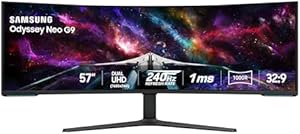
- Best for super-ultrawide immersion: Samsung Odyssey Neo G9. A partial match: a 57-inch dual UHD curved panel rather than a single 3840 x 2160 screen.
- Best for a smaller desk: ASUS ROG PG27UCDM. Its facts state a 26.5-inch 4K QD-OLED panel at 240Hz, in the narrowest stated width here, 24.0 inches.
Quick Answer
Choose the ASUS ROG PG32UCDP for the most flexible stated mode list: 4K at 240Hz for detail, FHD at 480Hz for speed. Choose the ASUS ROG PG27UCDM for the same 4K and 240Hz pairing in a smaller 26.5-inch QD-OLED frame. The Acer adds a stated 1700R curve, and the LG trades refresh down to a stated 165Hz while adding a stated 275-nit brightness. Treat the Samsung as a partial match only: a 57-inch dual UHD ultrawide, so confirm its double-width format on the product page.
Comparison Table
| Product | Screen size | Resolution stated | Refresh stated | Panel stated | Match |
|---|---|---|---|---|---|
| ASUS ROG PG32UCDP | 32-inch | 3840 x 2160 | 240Hz at 4K; 480Hz at FHD | WOLED | Match |
| LG 32GX850A-B UltraGear | 32-inch | 3840 x 2160 | 165Hz | Glossy OLED | Match |
| Acer Predator X32 X | 31.5-inch | 3840 x 2160 | 240Hz | QD-OLED, curved | Match |
| Samsung Odyssey Neo G9 | 57-inch | Dual UHD, as wide as two UHD monitors | 240Hz | Quantum Mini-LED, curved | Partial match |
| ASUS ROG PG27UCDM | 26.5-inch in facts | 3840 x 2160 | 240Hz | QD-OLED | Match |
Decision Guide
Settle the resolution format first. Four listings state the same single-panel figure, 3840 x 2160, the standard 4K UHD layout. The Samsung states a dual UHD format instead: one 57-inch panel carrying the width of two UHD monitors. That wider shape grades as a partial match and earns a product-page check rather than a direct comparison on pixel layout.
Next, weigh size against your desk. The 32-inch-class picks and the Acer state widths of about 28.1 inches, the smaller ASUS states 24.0 inches wide and 16.8 pounds, and the Samsung states 52.3 inches wide and 41.9 pounds, the largest stated footprint here.
Then compare refresh and response on stated figures only. At 4K, the ASUS pair, the Acer, and the Samsung each state 240Hz, while the LG states 165Hz; the LG’s 330Hz dual-mode figure appears in its product name only (product name), so treat 165Hz as its confirmed rate. Response time is stated at 0.03ms by the Acer and the ASUS PG27UCDM; the PG32UCDP’s and LG’s figures are product-name only (product name), and the Samsung states 1ms (GTG).
Finally, pick a panel type. The Acer states a DCI-P3 99 percent gamut and DisplayHDR True Black 400; the LG states the same certification with a 98.5 percent gamut. The Samsung’s Quantum Mini-LED panel is the only non-OLED option here.
1. ASUS ROG PG32UCDP 32 Inch OLED — Best for Dual-Mode Speed
This 32-inch WOLED monitor states the most flexible mode list here: 4K (3840 x 2160) at 240Hz, or FHD at 480Hz in its second mode. Its listing adds OLED anti-flicker technology, AI assistant features including dynamic crosshair, and an optional uniform brightness setting. At a stated 16.1 pounds it is the lightest monitor here.
Pros
- States both 4K at 240Hz and FHD at 480Hz in one panel
- 0.03ms response time (product name)
- Lightest stated weight here at 16.1 pounds
Cons
- The LG rival states a typical brightness of 275 nits; this listing gives no nit figure
- The Acer rival states a DCI-P3 99 percent gamut; this listing gives no gamut figure
| Spec | From the listing |
|---|---|
| Color | BLACK |
| Length | 10.8 inches |
| Width | 28.1 inches |
| Height | 22.8 inches |
| Weight | 16.1 pounds |
2. LG 32GX850A-B UltraGear OLED — Best for a Stated Brightness Figure

LG’s 32-inch UltraGear states a glossy 4K UHD (3840 x 2160) OLED panel with Micro Lens Array+ technology and a typical brightness of 275 nits. It carries VESA DisplayHDR True Black 400 certification with a stated DCI-P3 98.5 percent gamut and a 1.5M:1 contrast ratio. Its stated refresh rate is 165Hz, the lowest stated 4K rate here.
Pros
- Only listing stating a typical brightness figure, 275 nits
- States DisplayHDR True Black 400 and a 98.5 percent gamut
- Glossy OLED finish, the only glossy panel stated here
Cons
- The ASUS and Acer rivals state 240Hz at 4K; this listing states 165Hz, and its 330Hz figure is in the product name only (product name)
- The ASUS PG32UCDP states 16.1 pounds; this monitor states 20.1 pounds
| Spec | From the listing |
|---|---|
| Color | Black |
| Length | 9.8 inches |
| Width | 28.1 inches |
| Height | 24.4 inches |
| Weight | 20.1 pounds |
3. Acer Predator X32 X Curved QD-OLED — Best for a Curved QD-OLED

The Predator X32 X states a 31.5-inch curved 4K (3840 x 2160) QD-OLED panel with a 1700R curvature. Its listing states 240Hz, a 0.03ms (G to G) response time, a DCI-P3 99 percent gamut, true 10-bit color, and VESA DisplayHDR True Black 400. It is the only curved OLED here.
Pros
- States a 1700R curve, the only curved OLED here
- States a DCI-P3 99 percent gamut, the widest stated here
- States 240Hz with a 0.03ms response time in its facts
Cons
- The ASUS PG32UCDP states an FHD 480Hz second mode; this listing states one mode
- The ASUS PG27UCDM states 16.8 pounds; this monitor states 21.4 pounds
| Spec | From the listing |
|---|---|
| Color | Black |
| Size | 31.5-inch |
| Length | 13.62 inches |
| Width | 28.11 inches |
| Height | 21.5 inches |
| Weight | 21.4 pounds |
4. Samsung Odyssey Neo G9 57 Inch — Best for Super-Ultrawide Immersion
This is a partial match for the keyword: the Odyssey Neo G9 states a 57-inch dual UHD panel, described as a display as wide as two UHD monitors, rather than a single 3840 x 2160 4K screen. Its Quantum Mini-LED panel is curved, states 240Hz and a 1ms (GTG) response time, and states DisplayPort 2.1 in its facts. It states 52.3 inches wide and 41.9 pounds, so check the product page to confirm the format suits you.
Pros
- States the widest screen here, a 57-inch dual UHD curved panel
- States 240Hz and 1ms (GTG) with DisplayPort 2.1 in its facts
- States AMD FreeSync Premium Pro in its facts
Cons
- The other four listings state a single 3840 x 2160 panel; this one states a dual UHD format, graded a partial match
- The smaller ASUS states 24.0 inches wide; this monitor states 52.3 inches and 41.9 pounds
| Spec | From the listing |
|---|---|
| Color | Black & White |
| Size | 57-inch |
| Length | 19.7 inches |
| Width | 52.3 inches |
| Height | 24.0 inches |
| Weight | 41.9 pounds |
5. ASUS ROG PG27UCDM 27 Inch QD-OLED — Best for a Smaller Desk
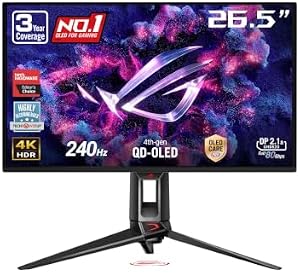
The smaller ROG states a 26.5-inch 4K (3840 x 2160) QD-OLED panel in its facts — note the size gap, since its product name carries 27 inch while the facts state 26.5-inch — with a stated 240Hz refresh rate and 0.03ms response time. Its listing credits fourth-generation QD-OLED technology, Anti-Flicker 2.0 with a stated flicker reduction of 20 percent, and OLED Care Pro with a proximity sensor.
Pros
- States 4K at 240Hz and 0.03ms in the narrowest frame here, 24.0 inches wide
- States OLED Care Pro with a proximity sensor for burn-in protection
- States Anti-Flicker 2.0 with a 20 percent flicker reduction
Cons
- Its product name carries 27 inch while its facts state 26.5-inch, so settle the size on the product page
- The PG32UCDP sibling states a dual-mode FHD 480Hz option; this listing states one 240Hz mode
| Spec | From the listing |
|---|---|
| Color | BLACK |
| Length | 8.6 inches |
| Width | 24.0 inches |
| Height | 21.6 inches |
| Weight | 16.8 pounds |
Shopping Checklist
- Measure your desk width and depth first, and compare them with each monitor’s stated width and length.
- Check stated dimensions and weight against your desk and any monitor arm limit.
- Confirm the resolution format you need: a single 3840 x 2160 panel, or a dual-width format like the Samsung’s.
- Check the stand and assembly requirements stated for each finalist.
- Check the return window on the product page before you buy.
- Compare two or three finalists side by side on stated size, refresh, and panel type, and do not buy a size you did not measure.
FAQ
How do I choose between a 27-inch-class and a 32-inch-class 4K monitor?
Start with viewing distance and desk depth. A 32-inch-class panel states a width of about 28.1 inches here, while the smaller ASUS states 24.0 inches wide with a 26.5-inch panel. Both sizes state the same 3840 x 2160 resolution in less space. Measure your desk, then check each finalist’s stated width and weight.
What is the difference between OLED and Mini-LED gaming monitors?
The Acer and the LG state DisplayHDR True Black 400; 0.03ms is stated by the Acer and the smaller ASUS, name-only for the PG32UCDP and LG (product name). The Samsung’s Quantum Mini-LED panel instead states a dual UHD ultrawide format with a 1ms (GTG) response time. Choose on the stated figures that matter for your games, and verify them on the product page.
What does a dual-mode refresh rate mean?
A dual-mode monitor states two modes at different resolutions. The ASUS PG32UCDP states 4K at 240Hz or FHD at 480Hz, trading pixel count for speed. The LG’s higher dual-mode figure appears in its product name only (product name), while its facts state 165Hz, so confirm any second mode on the product page.
Final Verdict
For a standard 4K gaming monitor, the ASUS ROG PG32UCDP is the leading stated package: a single 3840 x 2160 WOLED panel, 240Hz at 4K, a stated FHD 480Hz second mode, and the lightest stated weight here. The PG27UCDM repeats that pairing in a smaller frame, the Acer is the curved QD-OLED route with the widest stated gamut, and the LG is the pick for a stated 275-nit brightness figure. The Samsung remains a partial match: a capable 57-inch dual UHD ultrawide, but a different format from the single 4K panel the keyword describes.
Prime covers fast, free delivery on eligible items. See whether a Prime free trial is available for your account.
Check Prime on Amazon →Product and ASIN Reference
| Product | ASIN | Grade |
|---|---|---|
| ASUS ROG PG32UCDP | B0D7NNK43H | Match |
| LG 32GX850A-B UltraGear | B0FLQLPNNH | Match |
| Acer Predator X32 X | B0D8LFHH4D | Match |
| Samsung Odyssey Neo G9 | B0CDQM55C9 | Partial match — dual UHD ultrawide, not a single 3840 x 2160 panel |
| ASUS ROG PG27UCDM | B0DM6SHQTN | Match |

Write Your Review
No reviews yet. Be the first to share your experience!